REMIT · On-premise AI decision platform Built in Singapore
Decisions you can prove.
REMIT clears the routine cases in your queue, hands the uncertain ones to your people, and signs a proof record for every decision. Inside your own data centre.
Decide what you can prove. Defer what you cannot. Explain both.
Need forward-deployed engineering? See services
- 0
- cloud dependency. Runs entirely inside your walls.
- 100%
- of decisions carry a signed, verifiable proof record.
- 80–90%
- of routine cases handled without a person is the design point. Your pilot readout gives your number.
- 1
- named person on every case the system is not sure about.
Why not the alternatives
What a regulated queue actually needs
Four ways to automate a decision queue, against the questions your risk committee will ask.
| Rules engine | Cloud LLM API | On-prem chatbot | REMIT | |
|---|---|---|---|---|
| Data stays inside your perimeter | ||||
| Reads unstructured documents and messages | ||||
| Same input, same answer, every time | ||||
| Can only choose from your list of outcomes | ||||
| Knows when it is not sure and hands to a person | ||||
| Accuracy standard measured on your own past cases | ||||
| Signed proof record on every decision | ||||
| Who may act, per outcome, under dual control | ||||
| Survives a policy change | Rewrite the rules | Partly | Partly | Re-measure the standard |
How it works
Four steps. Four outcomes. One proof.
Every case takes the same path. What differs is where it stops.
Documents in
FOLIO
Reads
Messages, slips, claims and policies become one cited case record.
SIFT
Decides
A model trained on your workflow picks from your list of outcomes.
BOUNDS
Checks itself
Measures whether it is sure enough to act, against a standard set on your own cases.
BENCH
Brings in a person
Evidence, a suggestion and the decision go to a named reviewer.
Every case ends in one of four states
Handled
Clear. Decided and recorded.
Verify
One detail to confirm before acting.
Hand off
Two outcomes possible. A person decides.
Refer
Unlike anything seen before. Senior desk.
The proof record
Every state ends with a signed proof record: what was read, what was decided, by whom, and against which standard.
What a proof record containsWhat you can show a regulator
Proof, not promises.
The system does not tell you it is confident. It shows you the measurement, and it stops when the measurement says so.
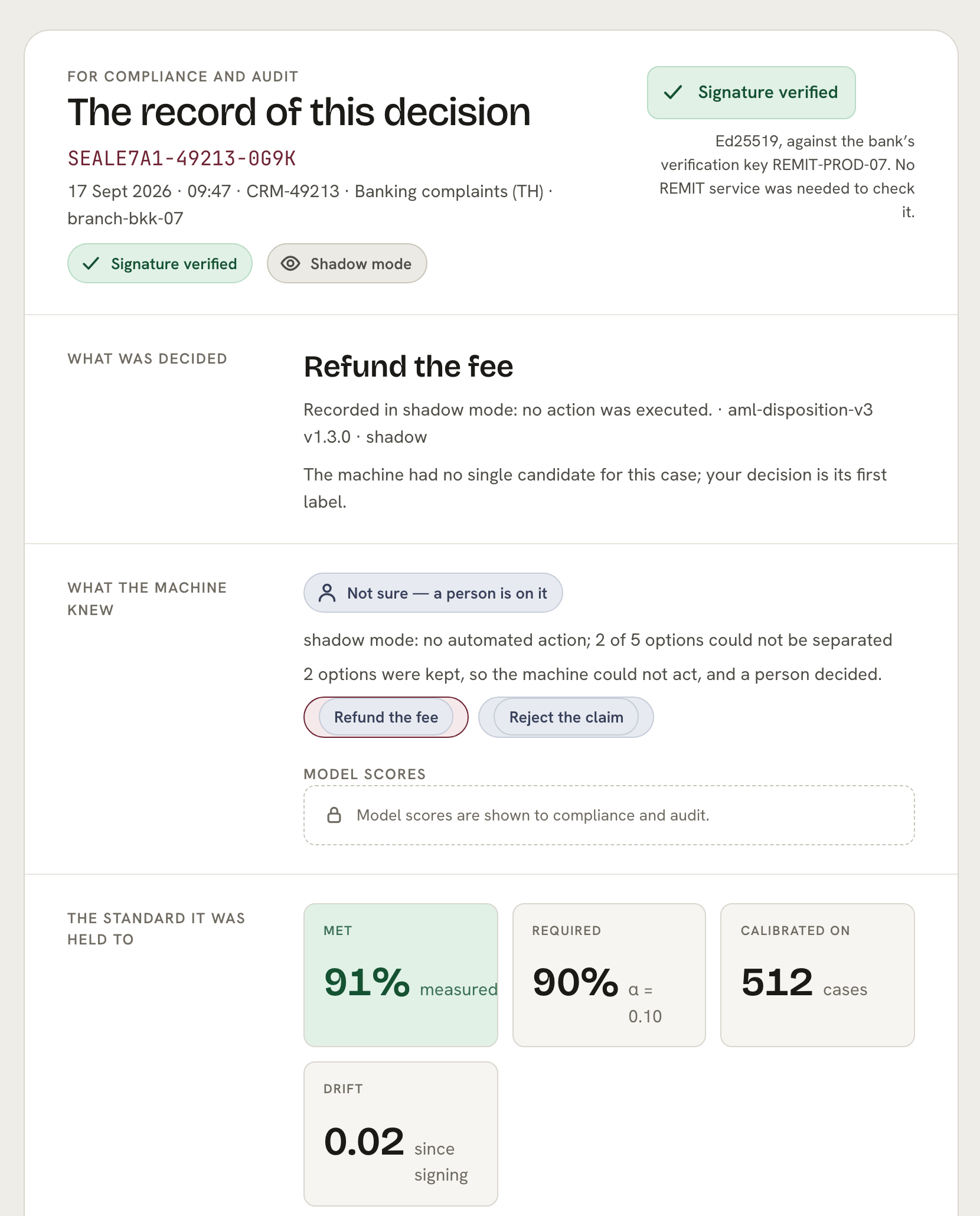
A standard you set, measured on your own cases.
Before go-live, REMIT is scored on hundreds of your past decisions. It only acts on its own where it meets the accuracy standard you require, and the number is on the record.
When it is not sure, it stops.
Two plausible outcomes means a person decides. A case unlike anything seen before goes to a senior desk. That is the design, not an exception.
Every decision has a signed record.
What was read, what was chosen, who approved it, and the standard in force. Verifiable with your own key, without us in the room.
What we do not claim.
Not that it is always right. The guarantee is about how often it is right across your cases, and it is void if your cases change, so a stale standard sends everything to people until it is re-measured.
Deployment
Your data never leaves your walls.
REMIT runs on your hardware, in your data centre, with no path to the internet. That is what makes a new system acceptable to a regulated buyer.
No internet path.
The system has no way to call out. Every decision is made on your premises.
Trained inside, too.
Adaptation to your workflow happens on a workstation in your building and is signed before it goes live.
Proof checks offline.
A regulator can verify any decision record with your public key. REMIT does not need to be running.
Use cases
Built for the queues that keep you up at night.
Banking complaints and alerts first. The same platform then serves claims, eligibility and case triage in other regulated sectors.
Who this is for
Systems Integrators
Regulated-AI capability under your brand, with proof records your clients’ auditors can read.
Regulated enterprises
Any operator with a high-volume decision queue, a data-residency obligation and a model-risk file to keep.
Mid-market operators
Decisions handled inside your own environment, in the local language and on the local channels.
How to start
Two weeks. Your servers. Your data. Zero actions taken.
REMIT starts in shadow mode: it reads, scores and records every case, but nothing executes. After two weeks you read how often your people agreed with it, per outcome, and license only what you choose.
How we engage
Four engagements. Fixed scope.
Every engagement is priced as a defined outcome, agreed at the end of Discovery, before any build starts. No hourly billing.
- 011–2 weeks
Air-gap readiness
A data-residency and model-risk gap analysis against your regime. Often the easiest first yes.
- 022–3 weeks
Discovery
Written specification, the list of outcomes for your workflow, architecture, and a calibrated scope for the build.
- 0310–14 weeks
Implementation
One workflow delivered end-to-end on REMIT, piloted inside your environment with your reviewers, and handed over.
- 04Quarter+
Embedded retainer
Dedicated forward-deployed capacity for SI partners or estates with several workflows.
Forward-deployed, not consulted.
A senior engineer embedded with your team. We don’t drop a deck and disappear.
Fixed scope, fixed price.
Outcome, timeline and price agreed up front.
You own the result.
You own the deliverable. SG Systems retains the platform.
SI partnership variant.
Delivery capacity under your brand, co-branded on request.
Scope, timeline and price are agreed at the end of Discovery, before the build starts. Platform licensing is per site and per workflow, never per token.
Ready to scope an engagement?
A 30-minute call. From there, the first paid step is an Air-gap readiness assessment or a Discovery engagement.
Start a conversation